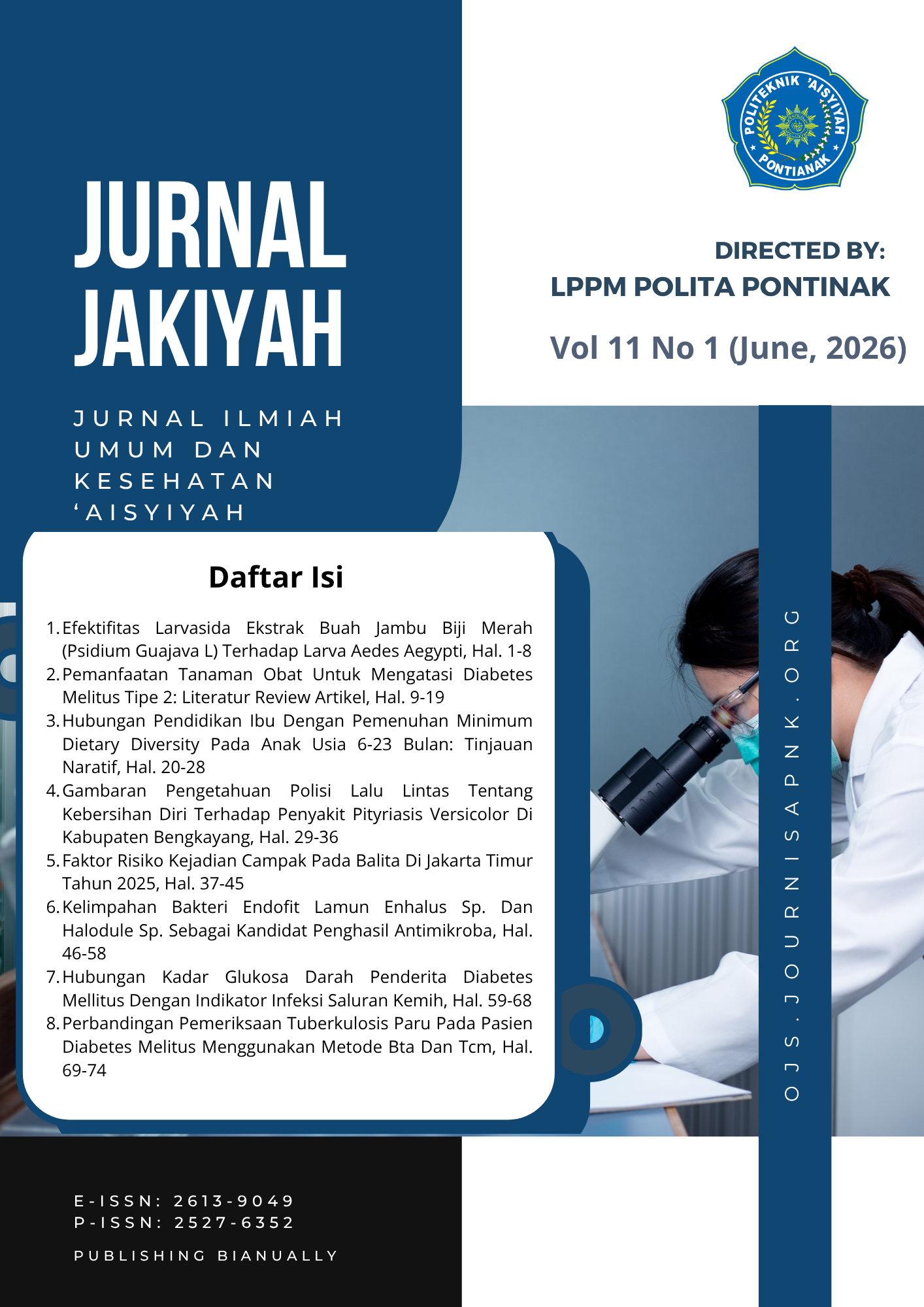
Kelimpahan Bakteri Endofit Lamun Enhalus sp. di Kuta Lombok Tengah dan Halodule sp. di Sekotong Lombok Barat
DOI:
https://doi.org/10.35721/jakiyah.v11iss1pp%25pKeywords:
Endophytic Bacteria, Enhalus sp, Halodule sp, Total Plate CountAbstract
atar Belakang: Ekosistem pesisir memiliki keanekaragaman hayati mikroorganisme yang tinggi, namun
eksplorasi bakteri endofit pada tumbuhan pesisir seperti lamun masih relatif terbatas. Kondisi lingkungan pesisir
yang memiliki berbagai cekaman ekologis berpotensi membentuk komunitas bakteri endofit yang khas, sehingga
penelitian mengenai kelimpahan bakteri endofit pada lamun menjadi penting untuk dilakukan.
Tujuan: Penelitian ini bertujuan untuk mengetahui kelimpahan serta karakteristik bakteri endofit yang diisolasi
dari lamun Enhalus sp. dan Halodule sp. yang berasal dari dua lokasi pesisir yang berbeda, yaitu Kuta Lombok
Tengah dan Sekotong Lombok Barat.
Metode: This research is a descriptive research. Penelitian ini merupakan penelitian deskriptif. Metode penelitian
yang digunakan meliputi isolasi bakteri endofit menggunakan metode Total Plate Count dengan teknik spread
plate pada media Nutrient Agar, dilanjutkan dengan pemurnian isolat serta karakterisasi makroskopis dan
mikroskopis.
Hasil penelitian: Hasil penelitian menunjukkan bahwa kelimpahan bakteri endofit berbeda antara kedua jenis
lamun, dengan nilai kelimpahan tertinggi diperoleh dari lamun Enhalus sp. (2,1x10³ ) dibandingkan Halodule sp.
(1,8x10³ ). Karakterisasi koloni menunjukkan variasi morfologi koloni yang meliputi bentuk, warna, tepian, dan
elevasi koloni, sedangkan hasil pengamatan mikroskopis menunjukkan adanya bakteri Gram positif dengan bentuk
sel dominan berupa basil dan kokus. Perbedaan kelimpahan bakteri endofit pada kedua jenis lamun diduga
dipengaruhi oleh karakteristik habitat serta kondisi lingkungan perairan di masing-masing lokasi.
Simpulan: Kelimpahan bakteri endofit Enhalus sp yang diisolasi dari lamun Pantai Kuta lebih tinggi
dibandingankan dengan bakteri endofit Halodule sp yang diisolasi dari lamun Pantai Sekotong.
References
1. Adamczyk, E. M., O’Connor, M. I., & Parfrey, L. W. (2022). Seagrass ( Zostera marina ) transplant experiment reveals core microbiota and resistance to environmental change. Molecular Ecology, 31(19), 5107–5123. https://doi.org/10.1111/mec.16641
2. Afifah, N., Putri, D. H., & Irdawati, I. (2018). Isolation and Identification of Endophytic Bacteria from the Andalas Plant Stem (Morus macroura Miq.). Bioscience, 2(1), 72. https://doi.org/10.24036/02018219952-0-00
3. Banister, R. B., Schwarz, M. T., Fine, M., Ritchie, K. B., & Muller, E. M. (2022). Instability and Stasis Among the Microbiome of Seagrass Leaves, Roots and Rhizomes, and Nearby Sediments Within a Natural pH Gradient. Microbial Ecology, 84(3), 703–716. https://doi.org/10.1007/s00248-021-01867-9
4. Bass, A. V., Falkenberg, L. J., & Thibodeau, B. (2025a). Seagrasses under stress: Independent negative effects of elevated temperature and light reduction at multiple levels of organization. Limnology and Oceanography, 70(S2). https://doi.org/10.1002/lno.12759
5. Bass, A. V., Falkenberg, L. J., & Thibodeau, B. (2025b). Seagrasses under stress: Independent negative effects of elevated temperature and light reduction at multiple levels of organization. Limnology and Oceanography, 70(S2). https://doi.org/10.1002/lno.12759
6. Bertagnolio, S., Dobreva, Z., Centner, C. M., Olaru, I. D., Donà, D., Burzo, S., Huttner, B. D., Chaillon, A., Gebreselassie, N., Wi, T., Hasso-Agopsowicz, M., Allegranzi, B., Sati, H., Ivanovska, V., Kothari, K. U., Balkhy, H. H., Cassini, A., Hamers, R. L., Weezenbeek, K. Van, … Rudan, I. (2024). WHO global research priorities for antimicrobial resistance in human health. The Lancet Microbe, 5(11), 100902. https://doi.org/10.1016/S2666-5247(24)00134-4
7. Destiana, E., Candri, D. A., & Ahyadi, H. (2024). Seagrass Meadow Conditions in Coastal Waters of Siwak Bay Central Lombok. Jurnal Pijar Mipa, 19(2), 273–279. https://doi.org/10.29303/jpm.v19i2.5519
8. Deutsch, Y., Gur, L., Berman Frank, I., & Ezra, D. (2021). Endophytes From Algae, a Potential Source for New Biologically Active Metabolites for Disease Management in Aquaculture. Frontiers in Marine Science, 8. https://doi.org/10.3389/fmars.2021.636636
9. Fahruddin, M., & Ilyas, A. P. (2023). Studi Kerapatan dan Tutupan Jenis Lamun di Perairan Pantai Ketapang, Kecamatan Sekotong Barat, Kabupaten Lombok Barat. Jurnal Kelautan: Indonesian Journal of Marine Science and Technology, 16(3), 217–221. https://doi.org/10.21107/jk.v16i3.19240
10. Fouda, A., Eid, A. M., Elsaied, A., El-Belely, E. F., Barghoth, M. G., Azab, E., Gobouri, A. A., & Hassan, S. E.-D. (2021). Plant Growth-Promoting Endophytic Bacterial Community Inhabiting the Leaves of Pulicaria incisa (Lam.) DC Inherent to Arid Regions. Plants, 10(1), 76. https://doi.org/10.3390/plants10010076
11. Hentati, F., Tounsi, L., Djomdi, D., Pierre, G., Delattre, C., Ursu, A. V., Fendri, I., Abdelkafi, S., & Michaud, P. (2020). Bioactive Polysaccharides from Seaweeds. Molecules, 25(14), 3152. https://doi.org/10.3390/molecules25143152
12. Huang, L., Fu, Y., Liu, Y., Chen, Y., Wang, T., Wang, M., Lin, X., & Feng, Y. (2024). Global insights into endophytic bacterial communities of terrestrial plants: Exploring the potential applications of endophytic microbiota in sustainable agriculture. Science of The Total Environment, 927, 172231. https://doi.org/10.1016/j.scitotenv.2024.172231
13. Jankowska, E., Jankowska, K., & Włodarska-Kowalczuk, M. (2015). Seagrass vegetation and meiofauna enhance the bacterial abundance in the Baltic Sea sediments (Puck Bay). Environmental Science and Pollution Research, 22(18), 14372–14378. https://doi.org/10.1007/s11356-015-5049-7
14. Lalu Zulkifli, Dwi Soelistya Diah Jekti, Nur Lestari, & Dewa Ayu Citra Rasmi. (2020). Isolasi Bakteri Endofit Dari Sea Grass Yang Tumbuh Di Kawasan Pantai Pulau Lombok Dan Potensinya Sebagai Sumber Antimokroba Terhadap Bakteri Patogen. Jurnal Biologi Tropis. https://doi.org/10.29303/jbt.v16i2.226
15. Lee, K.-S., Park, S. R., & Kim, Y. K. (2007). Effects of irradiance, temperature, and nutrients on growth dynamics of seagrasses: A review. Journal of Experimental Marine Biology and Ecology, 350(1–2), 144–175. https://doi.org/10.1016/j.jembe.2007.06.016
16. Miyajima, T., Nakamura, T., Watanabe, A., Morimoto, N., & Nadaoka, K. (2025). The grazing impact of megaherbivores on sediment accumulation and stabilization functions of seagrass meadows in a subtropical coral reef lagoon. Limnology and Oceanography, 70(7), 1835–1848. https://doi.org/10.1002/lno.70088
17. Mohapatra, M., Manu, S., Dash, S. P., & Rastogi, G. (2022). Seagrasses and local environment control the bacterial community structure and carbon substrate utilization in brackish sediments. Journal of Environmental Management, 314, 115013. https://doi.org/10.1016/j.jenvman.2022.115013
18. Nguyen, T.-D., Nguyen, T.-T., Pham, M.-N., Duong, H.-N., Pham, T.-T., Nguyen, T.-P., Nguyen, P.-T., Thi Nguyen, T.-U., Nguyen, H.-H., & Nguyen, H.-T. (2023). Relationships between endophytic bacteria and medicinal plants on bioactive compounds production. Rhizosphere, 27, 100720. https://doi.org/10.1016/j.rhisph.2023.100720
19. Nimbulkar, P., Gupta, G., Virkhare, U., Althubiani, A. S., Dutta, A., & Kher, D. (2025). Bacterial endophytes and their secondary metabolites: mechanisms of biosynthesis and applications in sustainable agriculture. Journal of Umm Al-Qura University for Applied Sciences. https://doi.org/10.1007/s43994-025-00233-6
20. Nurbayanti, E. S., Naura, D. A., Aprilliyanti, D. A., Ismayani, I., Adhawati, L., Auliya, L., Apriliani, L. A., Prayoghi, M. S., Arizmayadi, M. Y., Chandri, D. A., & Ghazali, M. (2024). Diversity of Seagrass in Sire Beach, West Nusa Tenggara. Jurnal Biologi Tropis, 24(2b), 191–202. https://doi.org/10.29303/jbt.v24i2b.8180
21. Olivia, M., Chen, P. W.-Y., Annabel, C. N., Chou, W.-C., Chen, J.-J., Mukhanov, V., Chao, C.-F., & Tsai, A.-Y. (2025). Dynamics of Microbial Abundance in Unvegetated and Seagrass Habitats: A Case Study. Journal of Marine Science and Engineering, 13(6), 1048. https://doi.org/10.3390/jmse13061048
22. Oukala, N., Aissat, K., & Pastor, V. (2021). Bacterial Endophytes: The Hidden Actor in Plant Immune Responses against Biotic Stress. Plants, 10(5), 1012. https://doi.org/10.3390/plants10051012
23. Pamungkas, D. B. P., Setyati, W. A., & Ryandini, D. (2023). Antibacterial Ability of Seaweed Endophytic Bacteria (Turbinaria ornata, Sargassum crassifolium, and Sargassum polycystum) Against Skin Disease Agents. Trends in Sciences, 21(2), 7282. https://doi.org/10.48048/tis.2024.7282
24. Pandey, S., & Alam, A. (2023). Isolation of endophytic bacteria from bryophytes and study of their morphological, biochemical and biofilm formation properties. Journal of Environmental Biology, 44(3), 351–358. https://doi.org/10.22438/jeb/44/3/MRN-5079
25. Potouroglou, M., Bull, J. C., Krauss, K. W., Kennedy, H. A., Fusi, M., Daffonchio, D., Mangora, M. M., Githaiga, M. N., Diele, K., & Huxham, M. (2017). Measuring the role of seagrasses in regulating sediment surface elevation. Scientific Reports, 7(1), 11917. https://doi.org/10.1038/s41598-017-12354-y
26. Prekrasna, I., Dzhulai, A., & Parnikoza, I. (2021). Preliminary estimates of the number and diversity of the culturable endophytic bacteria from Deschampsia antarctica and Colobanthus quitensis. Visnik Ukrains’kogo Tovaristva Genetikiv i Selekcioneriv, 19(1–2), 21–30. https://doi.org/10.7124/visnyk.utgis.19.1-2.1437
27. Rahfika, R., Rahman, I., & Paryono, P. (2024). Komposisi Jenis dan Tutupan Lamun di Perairan Dusun Pandanan, Sekotong, Lombok Barat. JURNAL SAINS TEKNOLOGI & LINGKUNGAN, 10(2), 282–295. https://doi.org/10.29303/jstl.v10i2.624
28. Rotini, A., Mejia, A. Y., Costa, R., Migliore, L., & Winters, G. (2017). Ecophysiological Plasticity and Bacteriome Shift in the Seagrass Halophila stipulacea along a Depth Gradient in the Northern Red Sea. Frontiers in Plant Science, 7. https://doi.org/10.3389/fpls.2016.02015
29. Sharma, M., Sood, G., & Chauhan, A. (2025). Bacterial Endophytes of Medicinal Plants: Applications and Recent Developments. Current Microbiology, 82(11), 519. https://doi.org/10.1007/s00284-025-04499-1
30. Sousa, A. M., Machado, I., Nicolau, A., & Pereira, M. O. (2013). Improvements on colony morphology identification towards bacterial profiling. Journal of Microbiological Methods, 95(3), 327–335. https://doi.org/10.1016/j.mimet.2013.09.020
31. Sun, Y., Song, Z., Zhang, H., Liu, P., & Hu, X. (2020). Seagrass vegetation affect the vertical organization of microbial communities in sediment. Marine Environmental Research, 162, 105174. https://doi.org/10.1016/j.marenvres.2020.105174
32. Syukur, A., Idrus, A. A. I., & Zulkifli, L. (2021). Seagrass-associated fish species’ richness: evidence to support conservation along the south coast of Lombok Island, Indonesia. Biodiversitas Journal of Biological Diversity, 22(2). https://doi.org/10.13057/biodiv/d220255
33. Tarquinio, F., Attlan, O., Vanderklift, M. A., Berry, O., & Bissett, A. (2021a). Distinct Endophytic Bacterial Communities Inhabiting Seagrass Seeds. Frontiers in Microbiology, 12. https://doi.org/10.3389/fmicb.2021.703014
34. Tarquinio, F., Attlan, O., Vanderklift, M. A., Berry, O., & Bissett, A. (2021b). Distinct Endophytic Bacterial Communities Inhabiting Seagrass Seeds. Frontiers in Microbiology, 12. https://doi.org/10.3389/fmicb.2021.703014
35. Tarquinio, F., Attlan, O., Vanderklift, M. A., Berry, O., & Bissett, A. (2021c). Distinct Endophytic Bacterial Communities Inhabiting Seagrass Seeds. Frontiers in Microbiology, 12. https://doi.org/10.3389/fmicb.2021.703014
36. Tripathi, A., Pandey, P., Tripathi, S. N., & Kalra, A. (2022). Perspectives and potential applications of endophytic microorganisms in cultivation of medicinal and aromatic plants. Frontiers in Plant Science, 13. https://doi.org/10.3389/fpls.2022.985429
37. Vasavi, J., Raveendra Reddy, M., Sarvani, B., & Madhan Mohan, M. (2023a). Isolation, morphological and cultural characterization of bacterial endophytes associated with different groundnut varieties. The Andhra Agricultural Journal, 70(4), 486–493. https://doi.org/10.61657/aaj.2023.73
38. Vasavi, J., Raveendra Reddy, M., Sarvani, B., & Madhan Mohan, M. (2023b). Isolation, morphological and cultural characterization of bacterial endophytes associated with different groundnut varieties. The Andhra Agricultural Journal, 70(4), 486–493. https://doi.org/10.61657/aaj.2023.73
39. Vogel, M. A., Mason, O. U., & Miller, T. E. (2020a). Host and environmental determinants of microbial community structure in the marine phyllosphere. PLOS ONE, 15(7), e0235441. https://doi.org/10.1371/journal.pone.0235441
40. Vogel, M. A., Mason, O. U., & Miller, T. E. (2020b). Host and environmental determinants of microbial community structure in the marine phyllosphere. PLOS ONE, 15(7), e0235441. https://doi.org/10.1371/journal.pone.0235441
41. Walker, L. DA., Gribben, P. E., Glasby, T. M., Marzinelli, E. M., Varkey, D. R., & Dafforn, K. A. (2024). Above and below-ground bacterial communities shift in seagrass beds with warmer temperatures. Frontiers in Marine Science, 11. https://doi.org/10.3389/fmars.2024.1374946
42. Wehbe, N., Bechelany, M., Badran, A., Al-Sawalmih, A., Mesmar, J. E., & Baydoun, E. (2024). A Phytochemical Analysis and the Pharmacological Implications of the Seagrass Halodule uninervis: An Overview. Pharmaceuticals, 17(8), 993. https://doi.org/10.3390/ph17080993
43. Wu, W., Chen, W., Liu, S., Wu, J., Zhu, Y., Qin, L., & Zhu, B. (2021). Beneficial Relationships Between Endophytic Bacteria and Medicinal Plants. Frontiers in Plant Science, 12. https://doi.org/10.3389/fpls.2021.646146
44. Zotchev, S. B. (2024). Unlocking the potential of bacterial endophytes from medicinal plants for drug discovery. Microbial Biotechnology, 17(2). https://doi.org/10.1111/1751-7915.14382.